What affects the cost of importing goods from Spain, Portugal, France and Italy
The cost of an import depends mostly on distance and on how much space and weight the goods take up on the vehicle – loading metres, pallet count and whether the pallets stack. Timing also matters, as do demand for trucks on that route that week, tolls, fuel prices and special requirements such as a reefer or a tail lift. That is why we don’t publish a price list: the calculator gives an indicative figure, and the binding price comes in our quote.
The factors at a glance
| Factor | Why it changes the price | What you can do |
|---|---|---|
| Distance and route | more kilometres means more fuel, tolls and driver time | nothing – but an exact address rather than just a region helps |
| Quantity (pallets, LDM) | you pay for the space the goods occupy | give exact dimensions and don’t build pallets needlessly tall |
| Weight | heavy goods may need a bigger vehicle even if they take little space | give the real weight, not a “just in case” estimate |
| Stackability | stacked pallets use half the floor space | agree packaging with your supplier that can take stacking |
| Timing | a fixed day or a rush limits the choice of trucks | allow a few days’ leeway on collection |
| Backhaul demand | trucks returning north from the south look for loads, and supply varies week to week | ask early and stay flexible |
| Tolls and fuel | tolls apply in practically every transit country, and diesel prices move | ask whether they are included or charged separately |
| Special requirements | a reefer, tail lift, crane or ADR dangerous goods narrow the options | state them in your request, not at collection |
Why the price changes on the same route
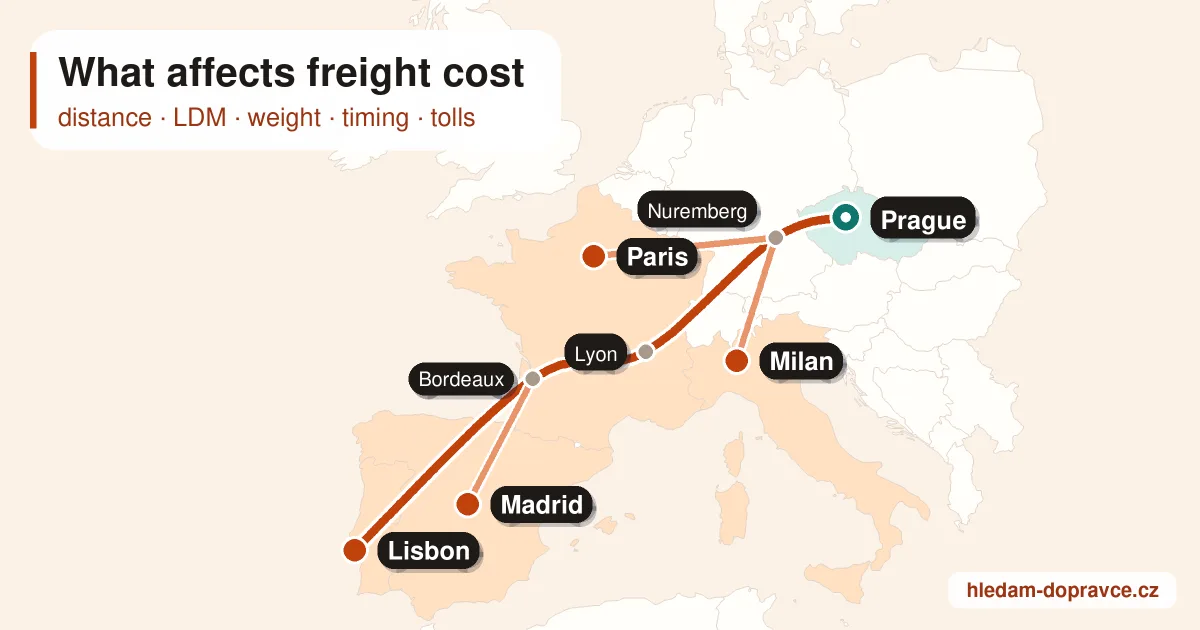
Road freight is a market. On the route from southern Europe to the Czech Republic, what matters is how many trucks are heading back north in a given week and how much cargo is waiting for them. In the season when Spain ships a lot of fruit and vegetables, trucks are scarcer and prices rise. When many trucks are returning empty from the south, cheaper capacity is easier to find. That is why the binding price is set in the quote, based on the situation at the time.
How much space the goods take: loading metres
A loading metre (LDM) is one metre of load-floor length across the full width of the vehicle. A 120 × 80 cm Euro pallet takes 0.4 LDM, a 120 × 100 cm industrial pallet 0.5 LDM, and a full trailer has 13.6 LDM. If your pallets are light but tall and can’t be stacked, you pay for space, not weight. With very heavy goods it is the other way round.
Tolls and fuel
A truck from Spain to the Czech Republic crosses several countries, each with its own road charges – motorway tolls in France, Italy, Spain and Portugal, and electronic lorry tolls in Germany, Austria and the Czech Republic. In Germany the toll rose in December 2023 with the addition of a CO₂ component. Diesel prices change all the time, which is why some carriers apply a fuel surcharge.
Checklist: how to get a more accurate and lower price
- Give exact collection and delivery addresses.
- Send the dimensions, height and weight of each pallet.
- Say whether the pallets can be stacked.
- Leave some leeway on the collection date.
- Combine several small orders from the same supplier into one shipment.
- Find out in advance how unloading will work, so you don’t need a pricier tail-lift vehicle.
What to ask when comparing quotes

- Are tolls and fuel included, or charged separately?
- After how many hours’ waiting at collection or delivery do waiting-time charges apply?
- Do you price by pallet, loading metre or weight?
- How long is the quote valid?
- What happens to the price if the supplier loads more pallets?
Compare like with like. A lower price that excludes tolls, or groupage instead of a part load, isn’t cheaper – it is a different service. How the options differ is explained in groupage, part load or full truck. Get an indicative price for your route in the calculator.