Looking for a carrier from Spain to the Czech Republic?
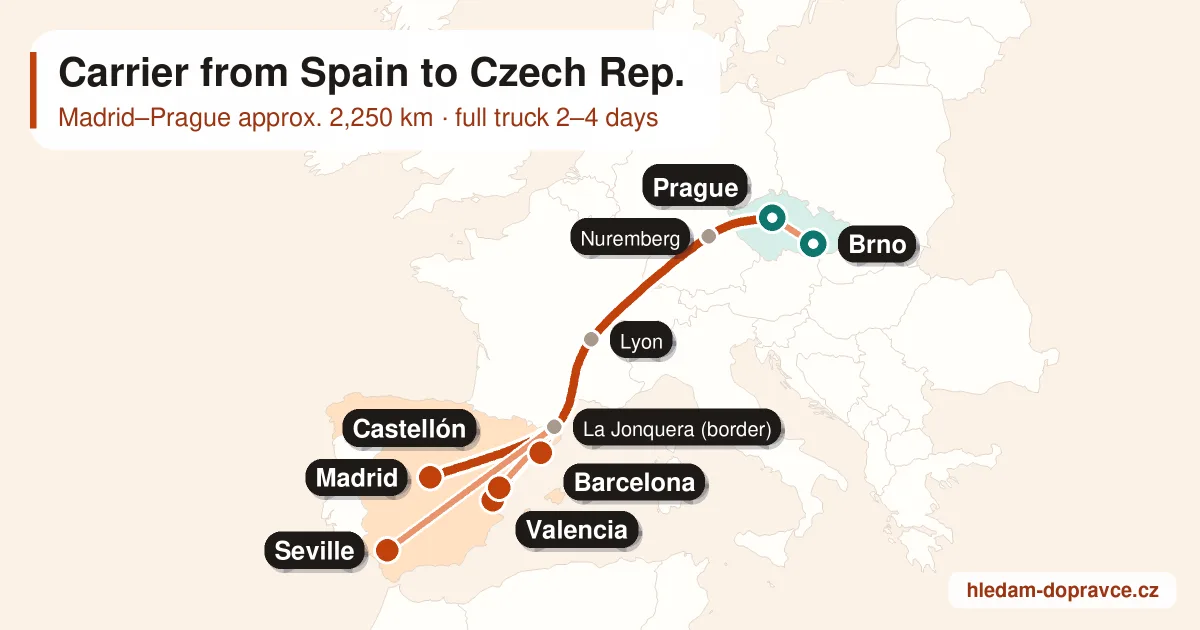
For imports from Spain you need a carrier that runs the route regularly: a full truck takes roughly 2–4 days to the Czech Republic depending on the region (Madrid–Prague approx. 2,250 km), groupage typically 5–7 working days. Before asking for a quote, get the exact collection address, the number and size of pallets and the warehouse opening hours from your supplier. We book the truck with a contracted carrier heading back north from Spain.
How far and how long: typical figures by region
| Collection region | Distance to Prague | Full truck |
|---|---|---|
| Catalonia (Barcelona) | approx. 1,750 km | 2–3 days |
| Aragon, Navarre, Basque Country | approx. 1,850–1,950 km | 3 days |
| Valencia, Castellón, Murcia | approx. 2,050–2,300 km | 3–4 days |
| Madrid area | approx. 2,250 km | 3–4 days |
| Andalusia | approx. 2,700 km | 4 days |
Transit time runs from loading. If the truck loads on a Friday afternoon, the weekend pushes arrival back, because lorry driving bans apply at weekends in Germany, France and Austria.
Which way the truck comes from Spain
From Catalonia, Valencia and the south, the route usually follows the Mediterranean to the La Jonquera border crossing and continues through southern France and Germany. From northern and central Spain, such as the Basque Country or Burgos, trucks often go via Irún and western France. What this means for you: a carrier coming from the north won’t necessarily have space for a collection in Andalusia, and vice versa. So give the exact place in your request, not just “Spain”.
What is most often imported from Spain
Ceramic wall and floor tiles from the Castellón area, olive oil, wine and other food, fruit and vegetables from Valencia, Murcia and Andalusia, furniture, footwear, textiles, car parts and goods for online shops. For food and drink, consider a reefer in summer; with tiles, watch the weight – a pallet of tiles is heavy, and the truck will max out on weight before it runs out of space.
Spanish warehouse habits to plan around

- Lunch break. Many warehouses don’t load in the early afternoon. Always confirm the time window.
- Fridays. Often an early finish – in summer, sometimes around midday.
- August. Many manufacturers scale back or close for the summer holiday.
- Public holidays. Besides national holidays, each region has its own; around Easter (Semana Santa) activity is reduced.
- Large logistics centres require a booked time slot for collection.
Checklist: what to get from your Spanish supplier
- the exact warehouse address – the registered office and dispatch warehouse are often different,
- number, size, height and weight of pallets, and whether they stack,
- the date the goods are ready, and the warehouse opening hours,
- the name and number of someone in dispatch who speaks English,
- the order number or reference for releasing the goods,
- the delivery term – under EXW or FCA, booking transport is up to you.
What to ask a carrier on the Spain–Czech Republic route
- Will the goods travel direct or via a groupage depot?
- If the goods are ready on Monday, when will you realistically collect?
- Which route will the truck take, and what transit time do you expect?
- Who will tell me when the goods are loaded and when the truck is due?
Documents and customs
Spain is in the EU, so there is no duty – an invoice and a CMR note are enough. The exceptions are the Canary Islands, Ceuta and Melilla, which lie outside the EU VAT area. The Balearic Islands are an ordinary part of the EU. For details, including who pays for transport under Incoterms, see import documents within the EU.
Why return trucks
Lots of trucks run regularly from the Czech Republic and central Europe to Spain, and they all have to come back. Our dispatch desk finds loads for those return runs, which is why we can offer a date even for smaller shipments. Send your request through the calculator – we will arrange collection with your Spanish supplier ourselves. For general advice on choosing a carrier, see our separate guide.