Looking for a carrier from Italy to the Czech Republic?
A full truck from Italy to the Czech Republic takes roughly 1–3 days: usually 1–2 days from the north (Verona, Milan), around 2 days from Rome and 2–3 days from the south. Groupage typically takes 3–5 working days. The route crosses the Alps and Austria, so weekend lorry bans, restrictions in Tyrol and Italian factories’ August shutdowns all affect transit times.
How long goods take from Italy, by region
| Collection region | Distance to Prague | Full truck |
|---|---|---|
| Verona, Veneto | approx. 800–900 km | 1 day |
| Lombardy (Milan, Bergamo, Brescia) | approx. 900–950 km | 1–2 days |
| Emilia-Romagna, Piedmont | approx. 1,000–1,100 km | 1–2 days |
| Tuscany, Rome | approx. 1,100–1,300 km | around 2 days |
| Southern Italy | approx. 1,500 km or more | 2–3 days |
The route over the Alps: what slows it down
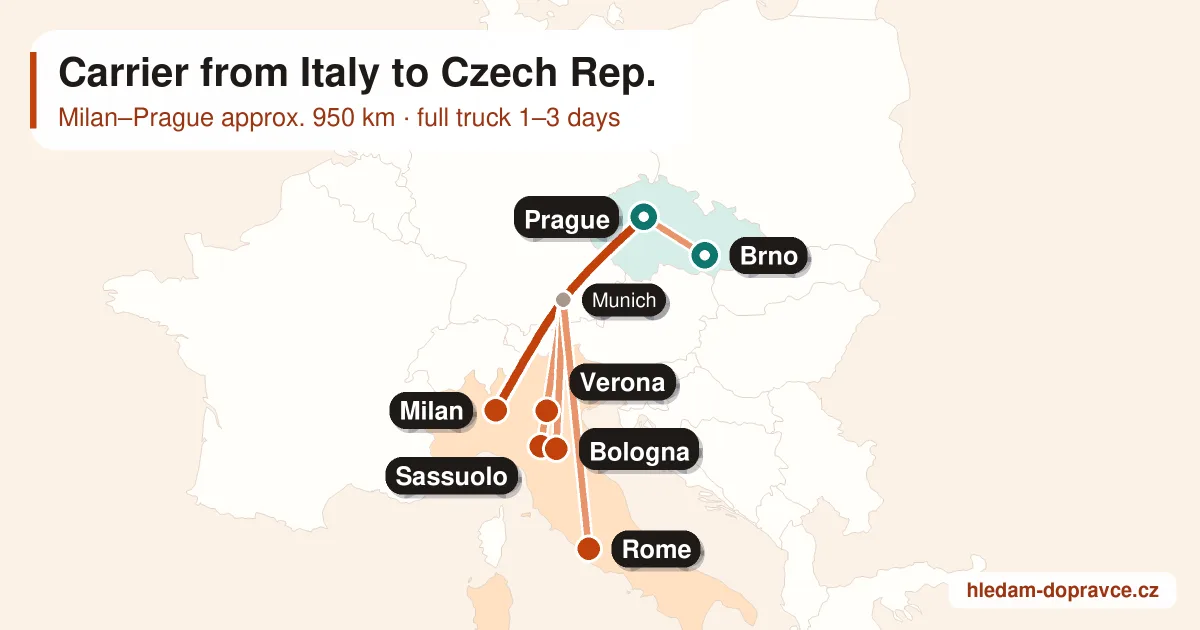
Trucks from Italy usually reach the Czech Republic via the Brenner Pass and Tyrol, or via Tarvisio and Carinthia. Tyrol has a night-time driving ban for lorries, and on some days trucks are let through the border with Bavaria in blocks, which causes queues. Within Italy, lorries are kept off the road on Sundays and public holidays, with extra summer Saturdays added to the list. A truck loaded on Friday afternoon will therefore often arrive only on Monday.
August and Ferragosto
Around the Ferragosto holiday (15 August) a large share of Italian manufacturers and warehouses close for the summer shutdown, often for two to three weeks. If you need goods for late summer, order so that they leave by early August at the latest, and confirm the collection date directly with the warehouse, not just with the salesperson.
What is imported from Italy
Tiles from around Sassuolo in Emilia-Romagna, furniture from Lombardy and Veneto, machinery and parts, metal and plastic components, textiles and fashion, pasta, cheese, wine and other food. The same applies to tiles as from Spain: weight, not pallet count, is what fills the truck. With furniture and other light, bulky goods it is volume that counts – consider a mega trailer with around 3 m internal height, described in truck and trailer types.
DDT: the Italian delivery note
Italian suppliers ship goods with a DDT (documento di trasporto), the Italian delivery note. Don’t confuse it with the CMR consignment note – that is issued by the carrier and evidences the international carriage. At delivery, check that the piece count on the DDT, the invoice and the CMR all match.
Checklist: what to get from your Italian supplier
- the collection address and loading hours, including any lunch break,
- number, size, height and weight of pallets, and whether they stack,
- the date the goods are ready, and whether the plant has a shutdown in that period,
- a dispatch contact we can deal with in English,
- the delivery term and who will load the goods,
- whether the DDT and invoice will travel with the shipment.
What to ask the carrier
- Which Alpine route will you take, and what transit time do you expect?
- If you load on Friday, when will you realistically arrive?
- Will the goods go direct or via a groupage depot?
- How will you let me know about loading and the expected arrival?
Documents
Italy is in the EU, so there is no duty, and an invoice and a CMR note are enough. The exceptions are small areas outside the EU VAT territory, such as the municipality of Livigno. Wine and other excise goods follow special rules – mention them in your request. More in import documents within the EU.
Send your request through the calculator; we will arrange collection with your Italian supplier ourselves. If you are unsure whether groupage or a dedicated truck is right, see groupage, part load or full truck.