Looking for a carrier from France to the Czech Republic?
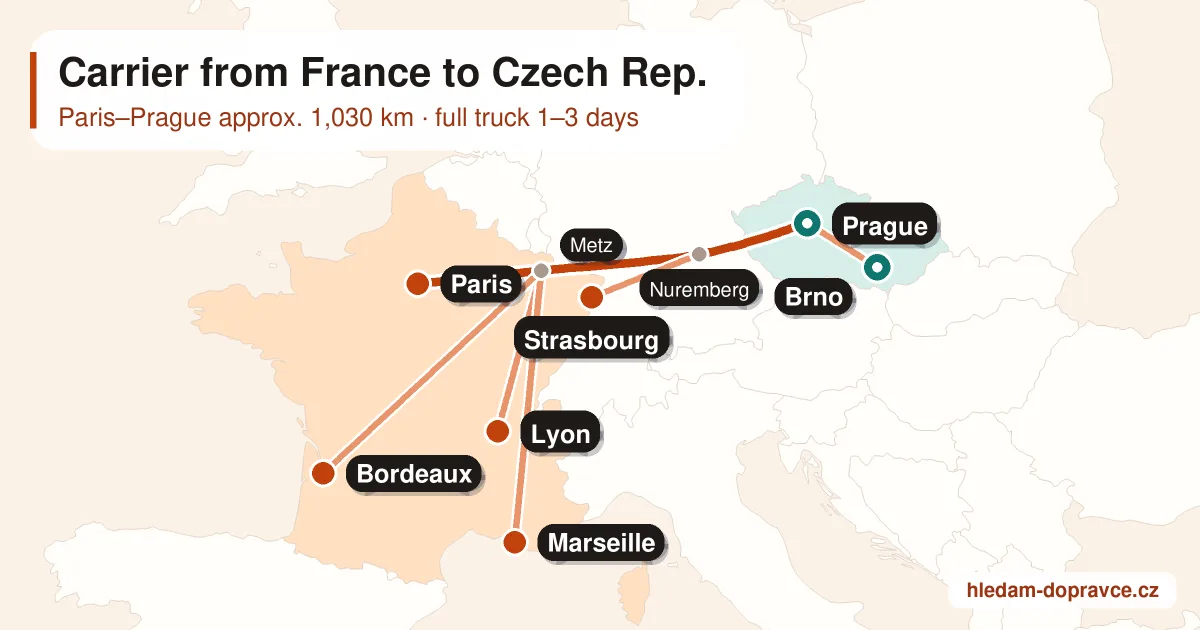
A full truck from France to the Czech Republic takes roughly 1–3 days: usually one day from Alsace and Lorraine, 1–2 days from Paris (approx. 1,030 km to Prague) and 2–3 days from the south. Groupage typically takes 3–5 working days. When planning, allow for France’s weekend lorry ban and for the fact that larger French warehouses only load at pre-booked times.
How long goods take from France, by region
| Collection region | Distance to Prague | Full truck |
|---|---|---|
| Alsace, Lorraine (Strasbourg, Metz) | approx. 650–750 km | 1 day |
| Paris area | approx. 1,030 km | 1–2 days |
| Lyon, Rhône-Alpes | approx. 1,100 km | 1–2 days |
| Bordeaux, Toulouse, Marseille | approx. 1,300–1,700 km | 2–3 days |
Trucks coming up from Spain pass through France, so French goods can often be added to a truck coming up from the Iberian Peninsula. For smaller shipments that is frequently quicker than waiting for a dedicated vehicle.
The weekend lorry ban: why Friday is too late
In France, trucks over 7.5 tonnes may not run from Saturday evening to Sunday evening, nor on the eve of and on public holidays. Germany’s weekend bans follow straight on. A truck that loads in southern France on Friday afternoon will therefore usually reach the Czech Republic on Monday or Tuesday. If you need the goods by the end of the week, book collection for Wednesday at the latest.
Booking a collection slot at French warehouses
Larger distribution centres and factories in France usually require a booked loading slot. Without one, the driver waits – or isn’t allowed onto the dock at all. The booking is made either by the supplier or by the carrier through the warehouse’s system, so agree in advance which of them will do it. Expect a lunch break too, when loading often stops.
Dealing with the warehouse
The salesperson you ordered from often speaks English, but the dispatch team may not. Ask your supplier for a warehouse contact who can manage in English, or ask them to pass the collection details on themselves. It saves misunderstandings about loading time and place, which cause most of the avoidable delays on the route from France.
Checklist: what to get from your French supplier
- the collection address, and whether the warehouse requires a booked slot,
- who will make the booking, and which number or reference the driver should quote,
- number, size, height and weight of pallets, and whether they stack,
- the date the goods are ready, and loading hours,
- a dispatch contact we can deal with in English,
- the delivery term – under EXW or FCA, booking transport is up to you.
What to ask the carrier
- Will the goods go direct, or be added to a truck coming from Spain?
- If you load on Thursday or Friday, when will the truck realistically arrive?
- Who will book the slot at the warehouse?
- Do you charge waiting time if the warehouse doesn’t keep to the booked slot?
What is imported from France
Wine and food, cosmetics and toiletries, building materials, machinery and parts, car parts, furniture and retail goods. For wine, food and cosmetics, consider a reefer in the warmer months – even a short route means a day or two inside a trailer.
Documents

France is in the EU, so there is no duty, and an invoice and a CMR note are enough. Goods subject to excise duty, such as wine, follow special rules – mention it in your request and check the procedure with your accountant. Who pays for transport under Incoterms is explained in import documents within the EU.
Send your request through the calculator; we will agree the collection date with your French supplier ourselves. If you also buy in Spain, the two shipments can often share one truck – see carrier from Spain.