Truck and trailer types: which one does your import need?
For ordinary palletised imports from southern Europe a curtain-sided vehicle is enough: depending on quantity, a van (8–10 pallets), a rigid truck (15–18 pallets) or an articulated truck with a 13.6 m trailer (33 Euro pallets). You need something special for temperature-sensitive goods (reefer), light but bulky goods (mega trailer), and sites without a loading dock or forklift (tail lift, crane). All figures below are typical values – individual vehicles vary.
Vehicles at a glance, with typical capacities
| Vehicle type | Load length | Euro pallets | Payload (typical) | Best for |
|---|---|---|---|---|
| Curtain-sided van (up to 3.5 t) | approx. 4–5 m | 8–10 | roughly up to 1 t | light and urgent consignments |
| Rigid truck | approx. 7–8 m | 15–18 | commonly up to ~6.5 t | part loads, urban deliveries |
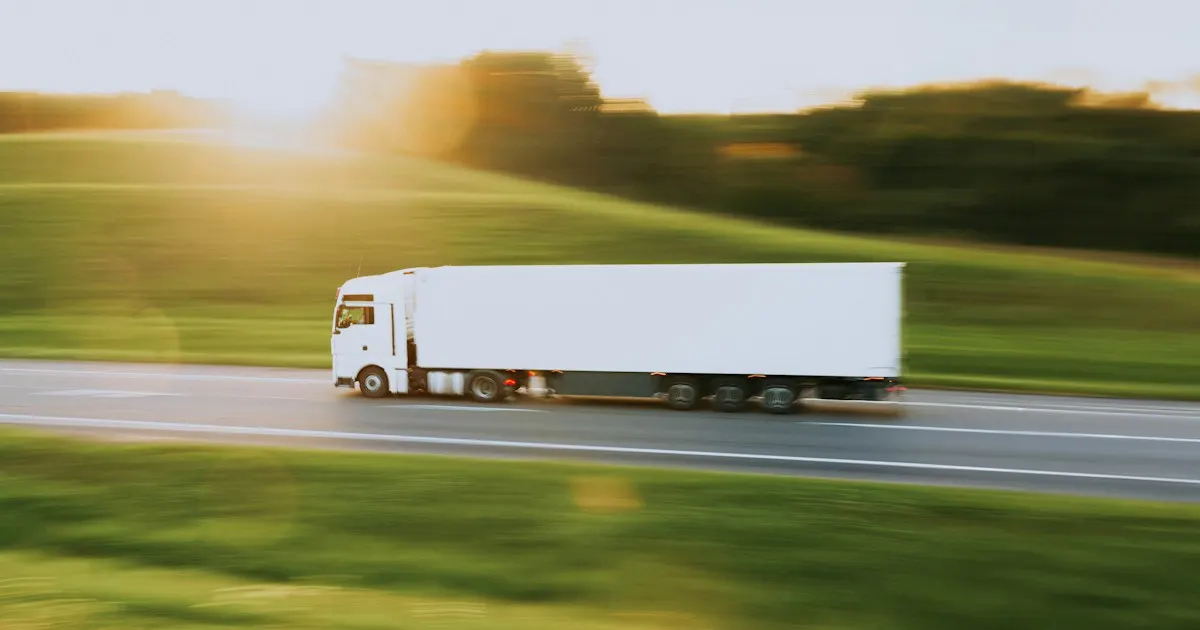
| Curtainsider trailer | 13.6 m | 33 | around 24 t | most palletised goods |
| Mega trailer | 13.6 m | 33 | slightly below standard | light, bulky goods, tall pallets |
| Refrigerated (reefer) trailer | approx. 13.3–13.6 m | 32–33 | lower, due to insulation and fridge unit | food, flowers, pharmaceuticals, cosmetics |
A Euro pallet measures 120 × 80 cm. A 13.6 m trailer takes 26 industrial pallets of 120 × 100 cm.
Van
A curtain-sided or box van is the smallest vehicle used for international imports. It is quick and suits a few light pallets, spare parts or samples. Weight is the limit: even if 8–10 pallets fit, it will usually carry only about a tonne. If a van over 2.5 tonnes gross weight crosses borders commercially, the operator needs a Community licence.
Rigid truck
A truck without a trailer, with a load floor of roughly 7–8 metres. It is more manoeuvrable than an artic, gets into town centres and smaller premises, and often has a tail lift. It suits part loads of around 7–18 pallets.
Curtainsider trailer
The workhorse of international haulage. A trailer with a 13.6 m load length and around 2.45 m width takes 33 Euro pallets. Its advantage is that it can be loaded from the rear, from the side, and from above once the curtain is pulled back – handy for long items or loading without a dock.
Mega trailer
It has a lower deck and an internal height of around 3 metres, so it offers more volume than a standard trailer. It pays off for light, bulky goods – furniture, insulation, packaging, textiles – and for tall pallets that wouldn’t fit a standard trailer even unstacked.
Refrigerated and insulated trailer
It holds a set temperature – chilled or frozen as required. Loading is from the rear only, normally at a dock. Temperature control is not just for food: in a southern European summer the heat inside a curtainsider can spoil chocolate, wine, cosmetics or some chemicals.
Vehicle with tail lift or crane
A tail lift is a platform at the back of the vehicle that raises a pallet from ground level. You need one if you have neither a loading dock nor a forklift. Its lifting capacity is limited, so give the weight of the heaviest pallet. A vehicle with a loader crane can unload building materials, machinery or containers where there is no handling equipment at all.
Checklist: what to tell the carrier so the right vehicle turns up
- number and size of pallets, and the height of the tallest one,
- total weight and the weight of the heaviest item,
- whether the goods can be stacked,
- how loading and unloading will work – dock, forklift, side loading, or nothing at all,
- the required temperature, if any,
- whether the goods are dangerous under ADR (if so, give the UN number; the vehicle and driver need the right equipment and training).
Questions to ask
- What are the internal height and width of the load space?
- Does the vehicle have a tail lift, and what is its capacity?
- Can the curtain be opened for side loading?
- Are there enough ratchet straps and anti-slip mats on board?
Which service to choose for your quantity is covered in groupage, part load or full truck. We are happy to suggest a vehicle from your details – just fill in the calculator.