How to choose a carrier for international imports
When choosing a haulier or freight forwarder for imports from southern Europe, check four things: that the company verifiably exists and holds a licence for international haulage or forwarding, that it has valid liability insurance, that it communicates clearly and on time, and that it can tell you where your goods are right now. Most trouble comes from offers that are far cheaper than all the others, with no traceable company behind them.
Haulier or freight forwarder – what is the difference?
A haulier (carrier) owns or operates trucks and physically moves the goods. A freight forwarder organises the move: finds a suitable vehicle, books the collection, keeps an eye on progress and handles the paperwork. Large, regular importers often deal with hauliers directly. If you only import now and then, a forwarder usually saves you time, because you don’t need to know the market or hunt for a truck for every shipment. We are a forwarder – we don’t own trucks and we book vehicles with contracted hauliers.
Checklist: what to verify before you book
- The company exists. Look it up in the company or trade register of its country. You can validate a foreign company’s VAT number in the European Commission’s VIES system.
- It is licensed. A haulier doing international road freight in the EU needs a Community licence; since May 2022 this also covers vans over 2.5 tonnes. A forwarder needs the relevant business licence in its own country.
- It is insured. Ask for the certificate of carrier’s (or forwarder’s) liability insurance. Check the cover limit, validity and exclusions – these often concern theft from unattended parking or certain types of goods.
- The offer is in writing. Price, route, collection and delivery dates, vehicle type and payment terms belong in an email or order, not just a phone call.
- You have a named contact. The name and number of the dispatcher handling your job, and a language they share with you and your supplier.
- You know how you will hear about progress. Will the haulier tell you when the goods are loaded and when the truck is arriving, or will you have to chase?
- Payment terms are normal. The standard is an invoice payable after delivery and receipt of the signed CMR note.
Questions to ask before you book

- Will my goods travel on your own vehicle, or will you subcontract? Who is liable if you do?
- When will I get the registration number and the driver’s name?
- Who will tell me if collection or delivery runs late?
- What is your insurance limit, and what does it exclude?
- When and how will I receive the signed CMR consignment note?
- What happens if the truck doesn’t turn up on the agreed day?
A reputable haulier or forwarder will answer these without hesitation. If the answer is “we’ll see”, treat that as useful information.
Warning signs
| Sign | Why it is a risk |
|---|---|
| Price far below every other offer | The job is often resold down a chain, or it is fraud. The difference usually shows up somewhere else. |
| Payment up front, or bank details changed by email | A classic fraud pattern. Always confirm a change of account by phone on a number you already know. |
| Only a mobile number and a free webmail address, no street address | The company can’t be traced, so nothing can be recovered from it. |
| Vehicle details arrive at the last minute or don’t match the booking | Risk of a “phantom carrier” who loads the goods and takes them elsewhere. |
| Refuses to show proof of insurance | If something goes wrong, there may be nothing to pay a claim from. |
| Doesn’t know the route’s quirks | Lunchtime closures at Spanish warehouses or weekend lorry bans in France, Germany and Italy lead to delays. |
Why price alone is the wrong yardstick
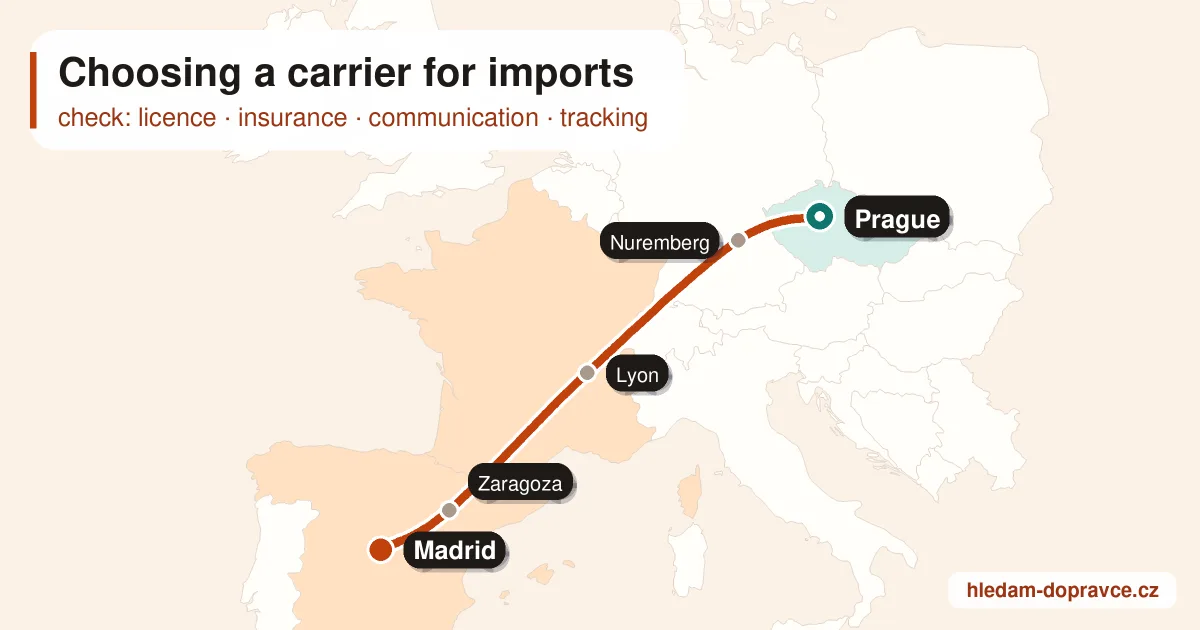
With imports from southern Europe, a reliable collection matters most. If the truck doesn’t arrive, the supplier won’t release the goods, the Spanish warehouse closes on Friday afternoon, and you wait until the following week. The cheapest offer ends up costing you days. We explain what drives the price in what affects freight cost, and how your goods are protected if they are damaged in CMR liability and cargo insurance.
If you would rather not find and vet a haulier yourself, send your request through the calculator – we will book a carrier we know.