Documents for importing within the EU, and Incoterms: who pays for transport?
To import goods from Spain, Portugal, France or Italy you need a commercial invoice, a CMR consignment note and usually a delivery note; there is no customs duty within the EU and no customs declaration. Who books and pays for transport is set by the Incoterms rule in the sales contract: the buyer under EXW and FCA, the seller under DAP and DDP. The exceptions are the Canary Islands, Ceuta and Melilla, where goods need customs paperwork.
Which documents do you need to import from another EU country?
| Document | Who issues it | What to check |
|---|---|---|
| Commercial invoice | seller | your VAT number, the delivery term, quantity and value |
| Delivery note (packing list) | seller | number of pallets and lines, weight – must match what actually ships |
| CMR consignment note | carrier; signed by sender, carrier and consignee | piece count, addresses, signatures and any reservations |
The CMR note is evidence of the contract of carriage and of the carrier taking over the goods. At delivery, it is where you record reservations if anything is missing or damaged.
Incoterms: who books and pays for transport?
Incoterms are rules published by the International Chamber of Commerce that set out who bears cost and risk along the way. Your order should state the rule with a place and version, for example “FCA Valencia, Incoterms 2020”.
| Rule | Who books transport | Who loads | When risk passes to the buyer |
|---|---|---|---|
| EXW – Ex Works | buyer | seller has no obligation to | when the seller makes the goods available at its premises |
| FCA – Free Carrier | buyer | seller, if the named place is its premises | once loaded onto the buyer’s vehicle |
| DAP – Delivered at Place | seller | seller | on arrival at the destination, before unloading |
| DDP – Delivered Duty Paid | seller | seller | as DAP, and the seller also pays import charges |
EXW or FCA? The practical difference

Under EXW the seller is not formally obliged even to load the goods. Most warehouses do so anyway, but if something is damaged during loading, the buyer bears it. FCA is usually safer for buyers: the seller loads, and risk passes only once the goods are on the vehicle. If your supplier offers EXW, ask whether they will load.
The seller also needs evidence that the goods left for another EU country, so that its sale can be zero-rated for VAT. That is why it may ask you for a copy of the signed CMR after delivery. Expect this and keep the note safe.
VAT and trade statistics – outside the transport job
When businesses in different EU countries trade with each other, the buyer usually accounts for VAT in the destination country as an intra-Community acquisition. How exactly to book it and whether you must file Intrastat returns is a question for your accountant; it is not part of the transport.
Exceptions: the Canary Islands, Ceuta and Melilla
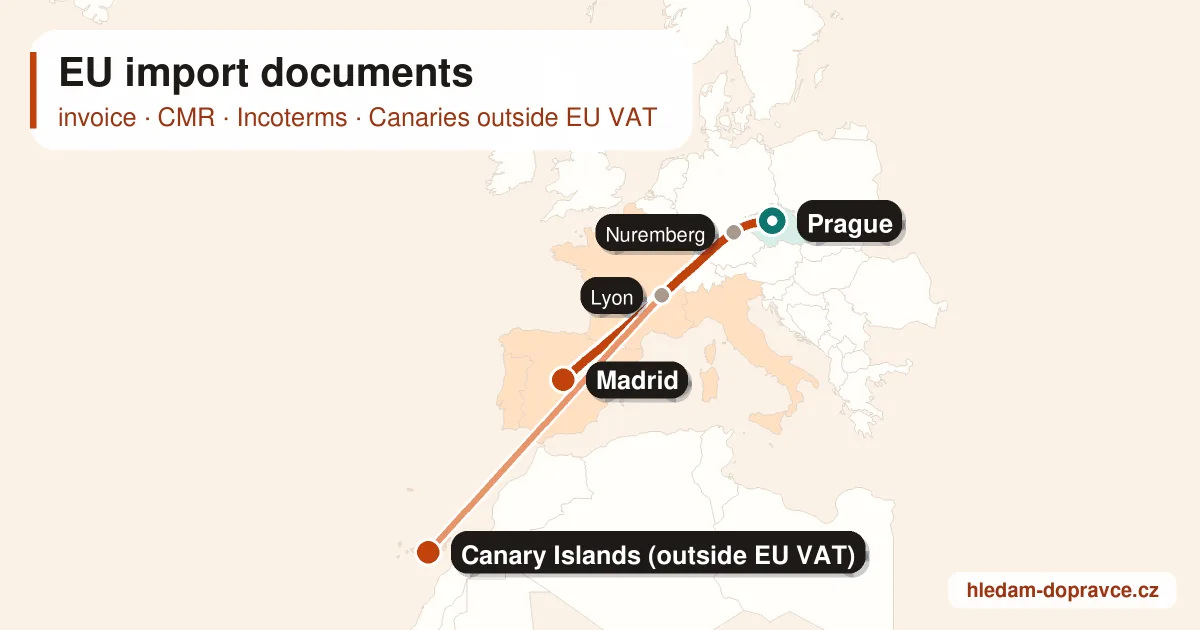
The Canary Islands belong to Spain and to the EU customs territory, but sit outside the EU VAT area. Goods from there therefore go through customs for VAT purposes. Ceuta and Melilla are outside both the customs and the VAT territory. The Balearic Islands (Mallorca, Ibiza, Menorca), by contrast, are an ordinary part of the EU. There are exceptions elsewhere too – in Italy, for instance, the municipality of Livigno.
Document checklist
- Before collection: does the invoice show your VAT number and the delivery term?
- Does the pallet count on the delivery note match your order?
- At collection: has the sender signed the CMR, with the piece count filled in?
- At delivery: count the pallets and check the packaging before you sign the CMR.
- After delivery: keep a copy of the CMR – the seller and your accountant may both need it.
Questions to ask your supplier
- Which Incoterms rule do you offer, and what is the delivered (DAP) price?
- Will you load the goods onto our vehicle even though you sell EXW?
- Can you email the invoice and delivery note in advance?
What to do if goods arrive damaged is covered in CMR liability and cargo insurance. If transport is your responsibility, request it through the calculator.